

Last updated: November 2, 2026
No wild mountain lions and no wild wolves live in Georgia. Coyotes do. They live in all 159 counties. Three rattlesnake species live across the state too. So the real trail risks in the north Georgia mountains are rattlesnakes first and coyotes a distant second. Lions and wolves are not hazards here, however often people ask about them.
That answer surprises a lot of hikers, because the four animals get asked about in one breath, as if they were one problem. They are not. Two of them are absent, and the two that are present need completely different responses.
Are There Mountain Lions in Georgia?
No. Georgia DNR says there is no confirmed breeding population of mountain lions in Georgia. The eastern cougar was wiped out of the state by the early 1900s through habitat loss and unregulated hunting. DNR still investigates reported sightings every year, and it has found no credible physical evidence of a population: no carcasses, no trail-camera pictures, no photographs or film.
The federal story matches. The U.S. Fish and Wildlife Service declared the eastern cougar extinct after a 2011 review, the last confirmed specimen having been killed in Maine in 1938, and removed it from the federal endangered list effective February 2018. The Florida panther is a different matter: a separate, still-endangered subspecies with a small population in south Florida, southwest of Lake Okeechobee, a long way from Georgia.
In the last 25 years, DNR counts only three credible mountain lion sightings in Georgia, and all three were Florida panthers. The best-known case was in 2008, when a hunter in LaGrange, in Troup County, shot a mountain lion while deer hunting; genetic testing later showed it was a federally endangered Florida panther, not a resident Georgia lion. Most reported sightings turn out to be bobcats, house cats, dogs, coyotes, bears, or river otters.
The bobcat is the usual confusion animal, and it is worth learning the difference. Bobcats are common in Georgia, but they are much smaller than a lion, with a short tail and a spotted coat. A lion is a long, plain-coated animal with a tail nearly as long as its body. For the full identification guide, see our post on bobcats in Georgia.
A real lion seen in Georgia, if one ever is, would most likely be an escaped or released captive animal, a few facilities in the state are licensed to hold captive mountain lions, or a transient Florida panther passing through. It would not be a resident wild lion. Report any sighting to the local DNR Wildlife Resources Division Game Management office, with the location, time, and anything you photographed.
None of that means you should walk into the woods unprepared for the one-in-a-million meeting. The National Park Service guidance is worth knowing even though you will almost certainly never use it in Georgia. Do not run, because running can trigger a chase instinct. Stand and face the animal, make eye contact, and do not crouch, since a standing human is not prey-shaped. Pick up small children without bending or turning away. Appear larger by raising your arms and opening your jacket. Speak firmly and loudly, throw stones or branches if it approaches, and fight back if it attacks. Do not play dead. Hike in groups and keep children close.
If you have read our Georgia bear guide, note the overlap and the difference. Like a black bear encounter, a lion encounter starts with standing your ground and never running. But a lion encounter also means never crouching down, which is not something a bear guide would stress. Sources: Georgia DNR on mountain lion sightings, National Park Service mountain lion safety guidance.
Are There Wolves in Georgia?
No. No wild wolf population lives in Georgia. The native wolf here was the red wolf, once widespread across the Southeast including Georgia. It was wiped out by the late 1960s through hunting, habitat loss, and predator-control programmes, and red wolves were declared extinct in the wild in 1980.
Captive breeding saved the species, and reintroduction began in eastern North Carolina in 1987, at Alligator River National Wildlife Refuge. The only wild population today is on North Carolina’s Albemarle Peninsula: the U.S. Fish and Wildlife Service counted 21 known or collared animals in August 2026, with a total estimate of 22 to 23 adults and subadults plus 14 to 15 pups, and about 295 animals in the captive breeding population. No reintroduction has happened in Georgia.
So a “wolf” seen in Georgia is almost certainly a coyote, a dog, or an escaped or released captive animal. Size is the quickest way to tell. Most Georgia coyotes weigh under 35 pounds, and one over 45 pounds would be very unlikely. A red wolf is a much larger, longer-legged animal. If the animal you saw was dog-sized and slight, it was a coyote, not a wolf.
Eastern coyotes do carry some historic wolf ancestry from interbreeding as coyotes expanded east. That is background, not a separate animal: there is no “coywolf” population living in Georgia, and coyotes should not be reported as wolves.
Captive red wolves also live in Georgia facilities, for example at Chehaw Park in Albany, a breeding partner in the recovery programme. Seeing a wolf at a zoo or a park is not a wild sighting. Source: U.S. Fish and Wildlife Service Red Wolf Recovery Program.
Are There Coyotes in Georgia?
Yes, and this is where the honest answer changes. Coyotes are common throughout Georgia in rural and urban settings, confirmed in all 159 counties. Thirty years ago they were confirmed in only about 23 counties, mostly in the southwest. Today they are statewide.
Coyotes are not native to Georgia. They filled the void left when red wolves were wiped out in the last century, expanding east from the West and Midwest from the 1950s onward, helped in Georgia by fox hunters who released coyotes for their dogs. Georgia DNR lists them as a non-native species.
Most coyotes here weigh under 35 pounds: a lean, medium-sized animal, not the large beast people picture when they hear a howl at night. Coyotes are most active at dawn and dusk, and urban coyotes have become more active at night to avoid people.
Coyote attacks on people are extremely rare, according to University of Georgia researchers, and when they do happen it is often linked to people feeding coyotes. A coyote seen in daylight is not automatically rabid, but one acting strangely, aggressive or unusually tame, may be ill and should be reported to DNR.
If you meet one on the trail, stay calm, and do not run or turn your back, because running triggers the chase instinct. Face it, make yourself big and loud. Hazing is the standard advice: yell, clap, wave your arms, and throw something in its direction. Keep dogs leashed and children close. Never feed coyotes. A fed coyote loses its fear of people, and a coyote that has lost its fear may have to be removed.
For pets, the rules are simple. Keep cats indoors, and supervise small dogs, especially at dawn and dusk, when coyotes are most active. One legal note, kept short: coyotes are a non-game animal in Georgia with no closed season. The full hunting-season picture belongs to our next safety guide. Source: Georgia DNR Coyote Fact Sheet.
Are There Rattlesnakes in Georgia?
Yes. Georgia has three rattlesnake species: the eastern diamondback, the timber rattlesnake, also called the canebrake in eastern and southeastern Georgia, and the pygmy rattlesnake. Only a handful of Georgia’s roughly 46 snake species are venomous, and three of them are rattlesnakes.
The eastern diamondback is the largest venomous snake in North America and the largest rattlesnake species on Earth. Adults are typically 3 to 6 feet, with the largest on record roughly 8 feet. It lives in Coastal Plain pine flatwoods, sandhills, and palmetto scrub, and it uses gopher-tortoise burrows. It is rare, a Georgia Species of Concern, and declining from habitat loss and killing on sight. Look for diamond blotches outlined in cream or yellow. You are unlikely to meet one on a north Georgia trail: its home is the Coastal Plain.
The timber rattlesnake is the one north Georgia hikers are most likely to meet. Timber and canebrake are one species with two names: “canebrake” in the east and southeast, “timber” in the north. It is found throughout Georgia except a few places in the extreme southwest, and the mountain form lives in north Georgia forests and hardwood bottoms. Adults are typically 3 to 5 feet, up to about 6 feet in the Coastal Plain. Its venom is potent and its yield is large, but it is generally even-tempered, and bites are uncommon because the snake prefers to avoid confrontation.
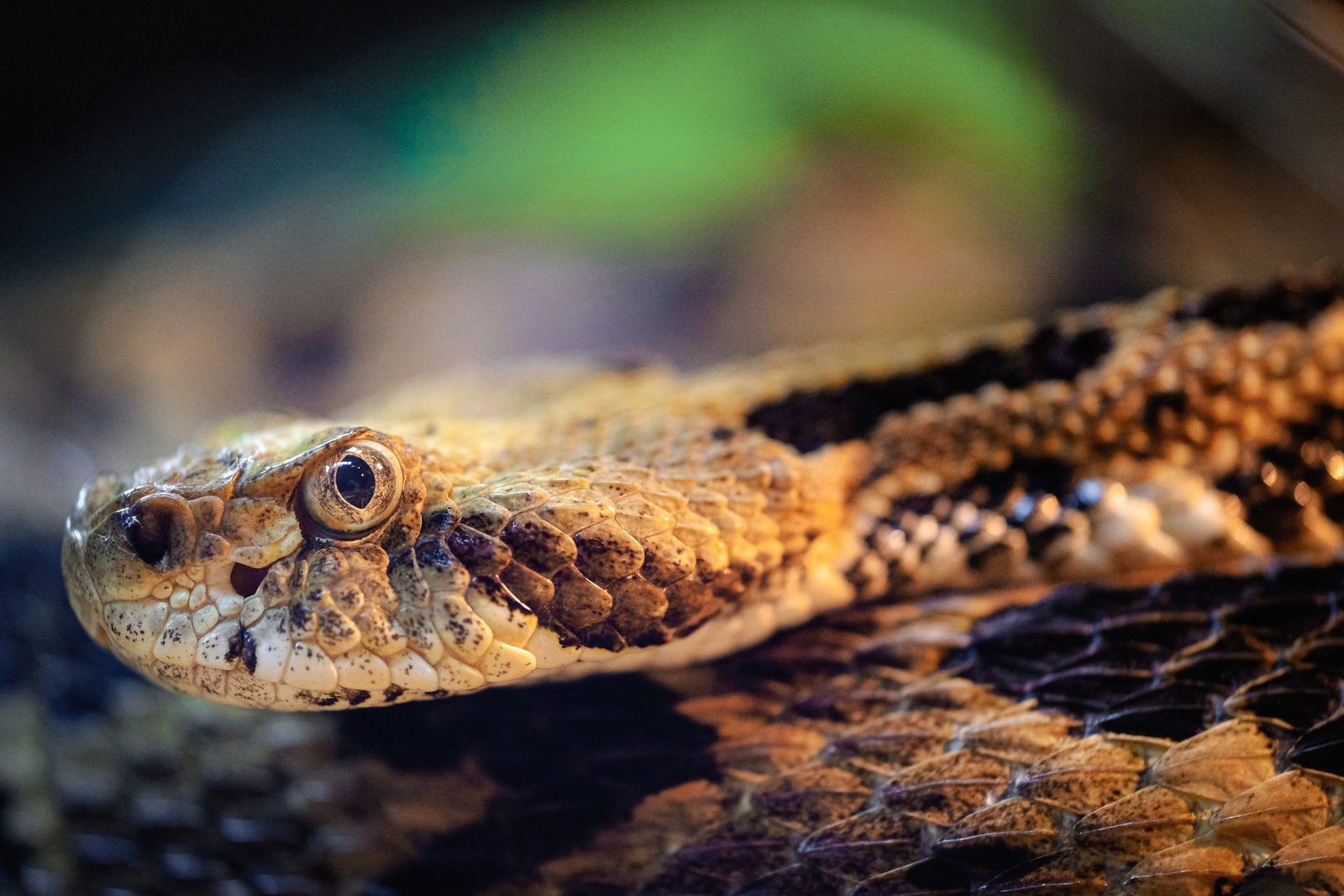
The pygmy rattlesnake is small, often under 2 feet, 14 to 23 inches, with a faint insect-like buzz rather than a loud rattle. It lives in wooded areas and floodplains, and in saw palmetto thickets in south Georgia. Its bite is painful and rarely life-threatening to adults. Georgia DNR notes that only the timber rattlesnake, the eastern diamondback, and the cottonmouth realistically represent a serious threat to human life.
Prevention is the whole game with rattlesnakes, and it is mostly about where you put your hands and feet. Watch where you step, sit, and put your hands. Never reach into rock crevices, hollow logs, or brush piles. Wear boots on the trail and stay on the trail. Give any snake at least six feet. If you hear a rattle, freeze, locate the sound first, then back away slowly. Do not jump or step blindly. The same hands-and-feet caution applies to scorpions in Georgia.
If someone is bitten, move away from the snake first, then call 911 and Poison Control at 1-800-222-1222. Keep the person calm and still. Remove rings, watches, and tight clothing before swelling starts. Keep the bitten limb still, around heart level, and get to an emergency department fast. Do not cut the wound, suck out venom, apply a tourniquet, apply ice or heat, or try to catch or kill the snake. Do not let the bitten person drive.
One legal note: it is illegal to kill non-venomous snakes in Georgia. The practical rule is simpler still. Do not kill any snake on the trail. Walk away and give it room.
Which of the Four Is the Real Risk on a North Georgia Trail?
Here is the honest geography, and it is the most important line in this guide. A hiker on a north Georgia mountain trail is very unlikely to meet any of these four animals at close range, and two of them are not there at all. Of the two that are, rattlesnakes come first and coyotes come a distant second.
The timber rattlesnake is the real trail animal of the four. It lives in the north Georgia forests and hardwood bottoms you are actually hiking through, and it is the one whose prevention rules, boots, staying on trail, watching your hands, are worth building into your habits. Coyotes are everywhere in the state, including the mountains, but on the trail you are far more likely to hear one at dusk than to see one, and a coyote that is hazed leaves. Plan for the snake. Know the coyote rules. Do not plan around lions or wolves.
That is also why the safety guides in this series pair up the way they do. Our bear guide covers the other large animal you might actually meet in the north Georgia mountains, and the advice there and here shares one core rule: stand your ground and never run. Our alligator guide covers the south Georgia water hazard, the mirror image of this one: alligators are a southern water problem, while these four are a statewide and mountain question. And if you want the ground itself, our Georgia mountains overview sets out the north Georgia habitat where timber rattlesnakes and coyotes actually live.
For trail choices, start with our best hikes in Georgia and our best north Georgia trails. Both cover the forested ridges and hardwood bottoms where a timber rattlesnake is a real, if uncommon, possibility.
Frequently Asked Questions
No. There is no confirmed breeding population, and the eastern cougar was wiped out of Georgia by the early 1900s. The only credible sightings in the last 25 years were Florida panthers passing through, including one shot by a hunter in LaGrange in 2008. Most reported sightings turn out to be bobcats.
No wild wolves live in Georgia. The native red wolf was wiped out by the late 1960s and declared extinct in the wild in 1980. The only wild population today is in eastern North Carolina. A “wolf” seen in Georgia is almost certainly a coyote, a dog, or an escaped captive animal.
Rarely. Coyote attacks on people are extremely rare, and they are often linked to people feeding coyotes. Coyotes live in all 159 counties and are most active at dawn and dusk. If one approaches, face it, make yourself big and loud, and do not run.
Three species: the eastern diamondback, the timber rattlesnake, also called the canebrake, and the pygmy rattlesnake. The timber rattlesnake is the one north Georgia hikers are most likely to meet. Only a handful of Georgia’s roughly 46 snake species are venomous.
Freeze, locate the sound first, then back away slowly, and give the snake at least six feet. Do not jump or step blindly, and do not try to move it. If someone is bitten, call 911 and Poison Control at 1-800-222-1222, keep the person calm and still, and get to an emergency department fast.
Stay calm, face it, and make yourself big and loud: yell, clap, wave your arms, and throw something in its direction. Do not run or turn your back. Keep dogs leashed and children close, and never feed coyotes.
No. It is illegal to kill non-venomous snakes in Georgia, and killing any snake on the trail is the wrong response in any case. Walk away and give it room. If you hear a rattle, the snake is warning you, not hunting you.


