

Last updated: November 15, 2026
Most hikers assume the Southern Appalachians welcome dogs everywhere. The truth is split down the middle, and getting it wrong can end a trip at the trailhead. In Great Smoky Mountains National Park, leashed dogs are allowed on exactly two trails: the Gatlinburg Trail and the Oconaluftee River Trail. Every other trail in the park, including the Appalachian Trail, is closed to dogs. The Blue Ridge Parkway is the opposite: most of its trails welcome leashed dogs, and the national forests around Asheville do too.
This guide sticks to trails where dogs are actually allowed, with the rule for each one checked before publishing. If you are still choosing a hiking partner, our guide to the best hiking dogs covers the breeds built for the trail. The Asheville trail hub lists the area’s main routes if you want to mix a dog-friendly pick with a longer day. If a trail is not on this list, do not assume it is dog-friendly. Check the park or forest page first.
The Smokies Rule Most Hikers Get Wrong
The Smokies are the most visited national park in the country, and they are also the strictest about dogs. Pets are welcome in frontcountry campgrounds, picnic areas and along roads, but the backcountry has been closed to dogs since the 1930s. The National Park Service pets page, last updated August 17, 2026, is clear: only two trails permit leashed pets, and the leash must be no longer than 6 feet at all times.
Gatlinburg Trail
The Gatlinburg Trail runs 1.9 miles one-way from Sugarlands Visitor Center to the edge of downtown Gatlinburg, 3.8 miles round trip. It is flat, wide and follows the West Prong of the Little Pigeon River the whole way, which makes it the easiest dog walk in the Smokies and one of the few places in the park where your dog can actually stretch its legs on a trail. The river gives dogs a place to cool off, and the flat grade suits older dogs and puppies still building stamina. It is also the only trail in the park where you can walk straight into a town for lunch afterward.
Oconaluftee River Trail
The Oconaluftee River Trail runs 1.5 miles one-way from the Oconaluftee Visitor Center toward Cherokee, North Carolina, about 3 miles round trip. It is the quieter of the two, a flat riverside path through open fields and woods along the Oconaluftee River. Elk graze the fields near the visitor center, so keep your dog close and on a short leash here. This is the better pick if you want the Smokies experience with your dog and without the Gatlinburg crowds.
That is the full list for the Smokies. Laurel Falls, Alum Cave, Chimney Tops, Rainbow Falls and Abrams Falls are all closed to dogs. So is the Appalachian Trail for its full length through the park. If a blog or a trail app tells you otherwise, it is wrong.
Blue Ridge Parkway: Where Dogs Are Welcome
The Parkway flips the Smokies rule. Dogs are allowed on most Parkway trails, picnic areas and overlooks, on a leash no longer than 6 feet and under your physical control at all times. Four picks below, all on open stretches of road. One stretch is still closed: mileposts 344.2 to 355.3, from NC Highway 80 to Mount Mitchell State Park, where recreation of any kind is prohibited while Helene repairs continue. The Park Service road-status page listed it closed on November 8, 2026, with completion targeted for the end of 2026. None of the picks below sits in that stretch, but check the road-status page the morning you drive.
Moses Cone Carriage Trails, Milepost 294
Moses Cone Memorial Park near Blowing Rock holds about 25 miles of wide, gravel carriage trails, and leashed dogs are welcome on all of them. The trails were built for horse-drawn carriages, so they are smooth, gently graded and wide enough for a dog, a stroller and a horse to pass each other. That makes this the best Parkway stop for dogs that pull, for puppies, and for older dogs that cannot handle rocky footing. The Flat Top Tower trail is the longer climb if you want a workout, and Bass Lake is the short, flat loop if you do not. Admission is free. Share the trails with horseback riders and give them the right of way.
Price Lake Loop, Milepost 296.7
Price Lake Loop is about 2.3 miles around Price Lake, a few minutes up the Parkway from Moses Cone. It is flat, shaded and easy, with lake views the whole way and a picnic area at the trailhead. Dogs must stay leashed, and the lake is the draw on a hot day. This is the pick for a first hike with a new dog, or for an afternoon walk when you want water nearby and no climbing at all.
Richland Balsam Nature Loop, Milepost 431
Richland Balsam is a 1.5-mile loop through spruce and fir forest at 6,410 feet, the highest summit on the Parkway. The trail is short and the footing is good, which makes it an easy dog walk with a real summit feeling. It is cooler up here than in the valleys, so this is a good summer pick when lower trails are hot. The loop is also one of the easiest beginner hikes near Asheville, and the dog rules are the same as everywhere on the Parkway: leash no longer than 6 feet, under your control.
Waterrock Knob, Milepost 451.2
Waterrock Knob is 1.2 miles round trip and short, but it is steep, so it suits fit dogs and owners who do not mind a climb. The payoff is a 360-degree view over the Smokies and the Blue Ridge from the highest viewpoint on the Parkway. It is also one of the best sunset hikes in the Blue Ridge Mountains. Go early or late in the day, when the parking lot is quieter and the rock is not baking in the sun. Keep your dog leashed on the summit rocks, where a slip would be a long fall.
Forest and Waterfall Trails That Allow Dogs
Outside the national park, the rules relax. In Pisgah and Nantahala National Forests, dogs must be on a leash or under physical control in developed recreation areas, including campgrounds, trails, trailheads and parking lots. Some Pisgah areas add a seasonal leash rule from April 1 to August 15, so read the trailhead sign before you unclip. DuPont State Forest, which is state land rather than federal, allows leashed dogs on its waterfall trails and charges no entry fee.
Moore Cove Falls
Moore Cove Falls is a 1.2-mile round trip in Pisgah National Forest, and it is the easiest waterfall walk on this list. The trail is gentle, the falls drop about 50 feet, and you can walk behind the curtain of water. Leashed dogs are allowed, and the short distance makes it a good first waterfall for a dog that has never hiked. The full waterfall guide for the Asheville area has the details, and this trail is the only waterfall pick here that sits in the national forest rather than a state forest or park.
Hooker Falls, DuPont State Forest
Hooker Falls is a 0.8-mile round trip on a mostly flat trail in DuPont State Forest, with 137 feet of gentle gain. The falls are only about 12 feet tall, but they pour into a wide pool that is one of the most popular dog swimming spots in the region. Leashed dogs are welcome on the trail and at the falls, and the forest is open 5 AM to 10 PM daily with free admission. The stairs down to the rock shelf at nearby Triple Falls are still closed after Helene, but the main overlooks are open. If your dog loves water, this is the pick.
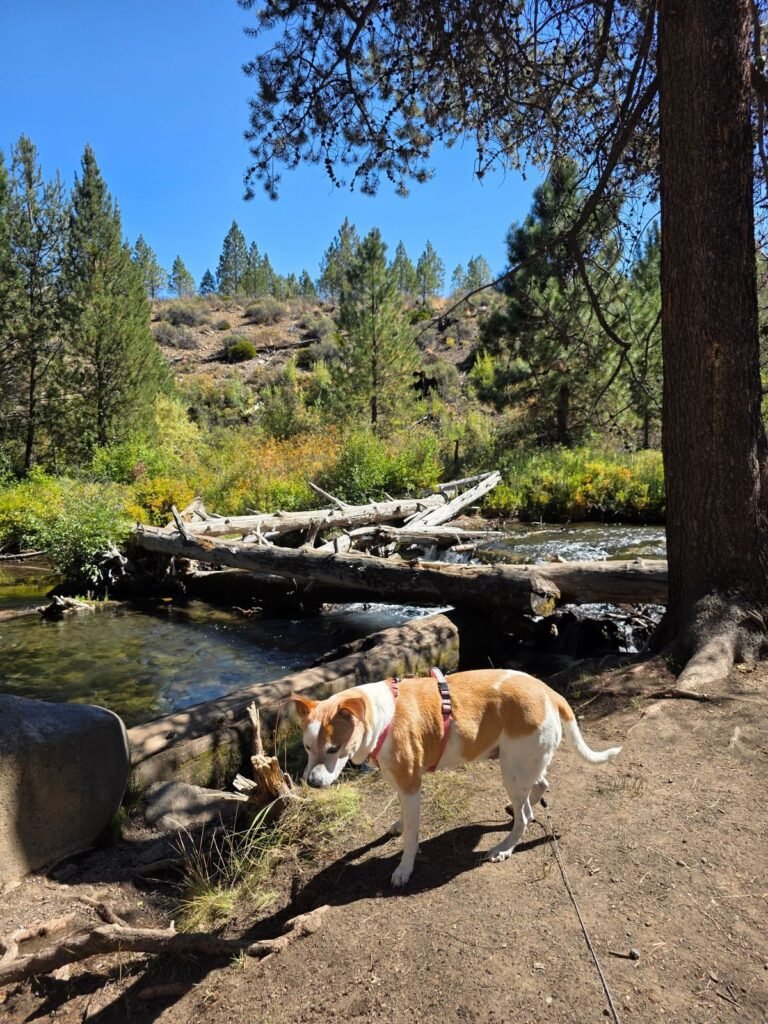
Graveyard Fields, Milepost 418.8
Graveyard Fields is a 3.2 to 3.5-mile loop off the Parkway near the Pisgah Inn, and it is the longest hike on this list. The loop crosses open meadows and streams to two waterfalls, and the shorter Lower Graveyard Falls walk is only a quarter mile out and back if your dog tires early. The trail is in Pisgah National Forest, so the leash rule applies. Go in late summer, when the wild blueberries ripen along the trail and the crowds thin out.
The Rules That Apply on Every Trail
The leash rule is the same almost everywhere in these mountains: 6 feet or less, and your dog under your physical control. A retractable leash does not count when it is extended past 6 feet, and “voice control” does not replace a leash in the Smokies or on the Parkway. Carry water for your dog and a collapsible bowl, because mountain streams are not a safe water source. Pack waste bags and carry them out; leaving a bag on the trailside is littering, not cleaning up. In summer, watch for heat: humid mountain air and dark rock can overheat a dog faster than you expect, and hot pavement in parking lots burns paws. Bears live in these mountains, and a loose dog that chases a bear puts you both in danger, so keep the leash short in bear country and know what to do if you meet one. Never leave a dog in a parked car, even with the windows cracked.
Where Dogs Cannot Go
Two places catch people out. The first is Stone Mountain Park in Georgia: the Walk-Up Trail does not allow dogs at all, so do not add it to a dog-friendly list. The second is the Smokies backcountry, which has been closed to dogs since the 1930s, including the Appalachian Trail through the park. Outside the park, leashed dogs are welcome on most of the Appalachian Trail in Georgia and North Carolina. If a trail is not listed as dog-friendly on the park or forest page, treat it as closed to dogs until you have checked.
Dog Hiking Checklist
Run through this list before every hike with your dog. Most of it is the same kit you pack for yourself, with a few dog-only additions.
- Leash on at all times, 6 feet or shorter. It is the rule on nearly every trail here.
- Water for your dog, plus a collapsible bowl. Dogs dehydrate faster than you think.
- Waste bags, and carry them out with you.
- Check paws at every stop. Hot rock, sharp gravel, and thorns cut pads.
- A small first-aid kit for your dog: bandages and tweezers for ticks.
- Tick check after every hike, every time.
- Keep your dog out of the Smokies backcountry trails. Dogs are not allowed on most GSMNP trails.
- Never let your dog chase wildlife or crowd other hikers and their dogs.
- In hot weather, hike early. Dogs overheat fast, and there is little shade on balds.
- Know the nearest vet to your trailhead before you go.
Frequently Asked Questions
Only on two trails. Leashed dogs are allowed on the Gatlinburg Trail (1.9 miles one-way) and the Oconaluftee River Trail (1.5 miles one-way), with a leash no longer than 6 feet. Every other trail in Great Smoky Mountains National Park is closed to dogs.
No. Dogs are banned from the Appalachian Trail for its full length through Great Smoky Mountains National Park, and from the entire Smokies backcountry. Outside the park, leashed dogs are welcome on most of the trail in Georgia and North Carolina.
Yes, on most of them. Dogs are allowed on Parkway trails, picnic areas and overlooks on a leash no longer than 6 feet, under your physical control at all times. Check the Park Service road-status page before you go, because mileposts 344.2 to 355.3 are still closed for Helene repairs.
Yes, in developed recreation areas. Dogs must be on a leash or under physical control on trails, at trailheads, in campgrounds and in parking lots. Some Pisgah areas add a seasonal leash rule from April 1 to August 15, so read the trailhead sign.
No. Dogs are not allowed on the Walk-Up Trail at Stone Mountain Park. Do not plan a dog hike there.
Water and a collapsible bowl, a 6-foot leash, waste bags, a towel, and a small first-aid kit with paw balm and tweezers for ticks. Carry more water than you think you need, and do not rely on streams.
Yes. The pool below Hooker Falls in DuPont State Forest is a popular dog swimming spot. Keep your dog leashed on the trail, watch the current after rain, and keep your dog out of the water if the flow is high.


